
What a 400-Year-Old Wall Can Teach a $10 Million Home


The Century That Chose Speed Over Truth
In the middle of the twentieth century, the construction industry made a decision. Not a design decision — an economic one. Gypsum board could be manufactured at scale, shipped on pallets, screwed into metal studs, and finished in a fraction of the time lime plaster required. The result looked similar enough at handover. The accounting was unambiguous.
What the spreadsheet did not capture was everything that happened afterward. Drywall traps moisture. It provides the dark, damp interior environment that mold requires to colonize a wall cavity. It off-gasses volatile organic compounds from its paint and adhesive systems for months after installation. It cracks under the thermal expansion and contraction of a building that breathes. And after ten or fifteen years — in a region like the Caribbean, often sooner — it needs to be torn out and replaced entirely.
The hammam in Fez never needed to be torn out. That is not a romantic observation. It is an engineering one.
Progress, they called it. What they had actually done was trade a material that lasted centuries for one that lasted a decade — and call the difference efficiency.
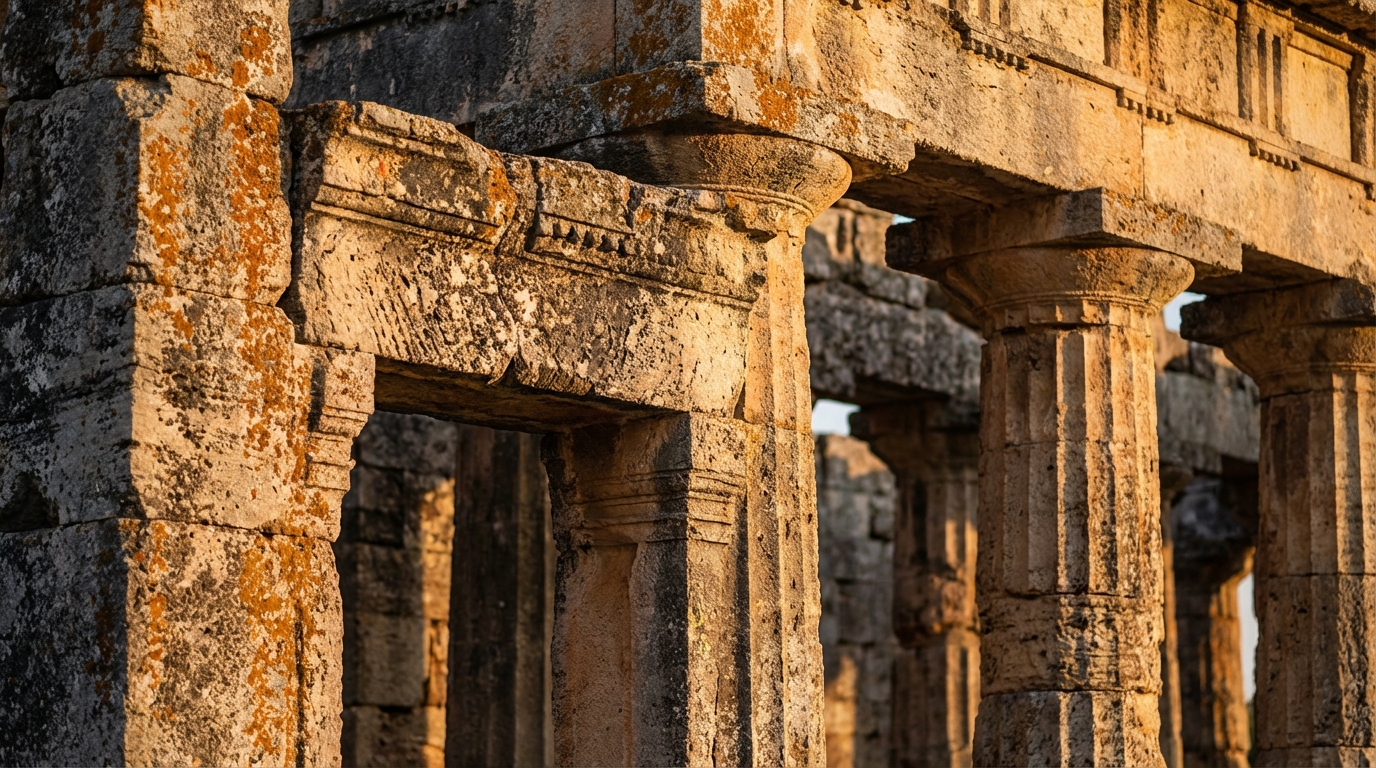
What Three Thousand Years of Continuous Use Actually Proves
The aqueducts of Rome were sealed with lime plaster. They carried water across the empire for centuries without the benefit of modern sealants, polymer additives, or maintenance crews with access to contemporary chemistry. They worked because lime plaster is hydraulically active — it cures harder and denser when exposed to moisture, rather than degrading under it. The Romans did not know chemistry. They knew the result.
The imperial palaces of Morocco — built under the Sa'adian and Alaouite dynasties — used Tadelakt, the polished lime plaster native to the Marrakech region, in their hammams and reception halls. Tadelakt is sealed with olive soap, rendering it naturally waterproof and biocidal. The artisans who applied it earned their training over years, not weeks. The result was a surface so refined it still serves as the reference point for luxury interior design in 2026.
The great palazzi along Venice's Grand Canal — built in a city constructed on water, in a climate of extraordinary humidity — were finished in Venetian plaster, a lime-based system that has kept those interiors intact for three centuries. In a city where salt air and tidal flooding would destroy most modern wall systems within a generation, lime held. Not by accident. By chemistry.
These are not aesthetic case studies. They are performance records, compiled across continents and centuries, in conditions that would destroy every synthetic finish currently on the market.

What It Means for a Residence Built in 2026
Puerto Rico and the wider Caribbean present conditions that have always separated serious materials from fashionable ones: sustained heat, salt air, tropical humidity exceeding 80% for most of the year, and hurricane-force wind events that have become the new baseline rather than the exception. In this climate, a wall finish is not a cosmetic decision. It is an infrastructure decision.
Lime plaster is hygroscopic — it absorbs excess humidity from interior air and releases it gradually as conditions change. This passive moisture regulation suppresses mold growth without mechanical intervention, chemical treatments, or any operating costs whatsoever. In the same climate where synthetic wall systems develop mold colonies within wall cavities within two to three years, lime plaster is actively hostile to the organism. Its natural alkalinity — a pH of approximately twelve — renders the surface biocidal. Mold cannot colonize it.
Its thermal mass moderates interior temperatures, meaningfully reducing air conditioning demand — a significant consideration in a territory where cooling costs rank among the highest in the United States. It is fully non-combustible, releasing no toxic gases under heat. And it accommodates the structural movement of a building under thermal cycling — expanding and contracting without fracturing — rather than developing the hairline cracks that invite saltwater and accelerate structural corrosion in rigid alternatives.
None of these properties was engineered in a laboratory last year. They were demonstrated in a hammam in Fez six hundred years ago. The laboratory simply confirmed what the wall already knew.
On Taste, and What It Actually Requires
There is a question behind the material question — one that the most discerning clients eventually arrive at, usually after the renovation that disappointed them. It is not: which finish is most beautiful? Beauty is available in many forms and at many price points. The question is: which finish reflects the fullest understanding of what a space is for?
A residence built at the level we are discussing — where the architecture, the furniture, the site, and the light have all been chosen with exceptional care — deserves a wall finish that participates in that intention rather than merely accommodating it. Lime plaster participates. It responds to light throughout the day in ways flat surfaces cannot, creating a room that looks different at eight in the morning than at eight in the evening. It invites touch. It ages into something richer rather than something worse. It carries in its material composition a direct line to the greatest interiors in human history.
Choosing a synthetic finish for a $10 million home is not a budget decision. It is a taste decision — or rather, the absence of one. It is what happens when the surface is treated as the last consideration rather than the first.
The most sophisticated choice available in 2026 and beyond was perfected in a century that did not yet have the word "trend." That is not a coincidence. It is the definition of taste.